

Guide: How to choose a lamp shade
Guide to choosing a lampshade
It is not always easy to find the right lampshade. What size fits the lamp, and should the shade be round, oval, or angular? With more than 40 years of experience and one of Denmark's largest selections of lampshades, we have gathered our best advice in this guide to help you more easily find a shade that fits both your lamp and your taste.
Bring your lamp along – we will help you
If you have the opportunity to visit our store in Odense, please do bring your lamp. Here we can try different shades on the lamp and assist with size, shape, and mounting.
We also have extensive experience with shade holders and the small mounting parts often needed to make everything fit together. You just need to bring the lamp and let us show you the options – then you can choose the shade you like best.
Get help choosing a lampshade via email
If you live too far to visit us in Odense, we are also happy to help remotely. Send us pictures and measurements of your lamp along with your wishes for the new shade, so we can assess which options fit best.
Further down the page, you will find instructions on which pictures and measurements we need and how to send them to us.
The guide primarily concerns lampshades for table lamps, but we also have shades for floor lamps, wall lamps, and chandeliers.
Send us pictures of your lamp – we will help you
Have you read the guide but are still unsure which lampshade fits your lamp? We are happy to help you find a solution.
To advise you best, we need some pictures and measurements of your lamp. Please send us the following:
- A picture of the entire lamp – preferably standing or lying on the floor with a measuring tape beside it so we can see the size of the lamp.
- The lamp's height – measure from the bottom of the lamp to the spot the arrow shows in the picture below, excluding the socket itself.
- A close-up of the socket – so we can see which type of socket the lamp has and which shade holder or accessories might be needed.
- Your wishes for the lampshade – please tell us if you want a round, oval, or angular shade, and if you have specific preferences for color, size, or material.
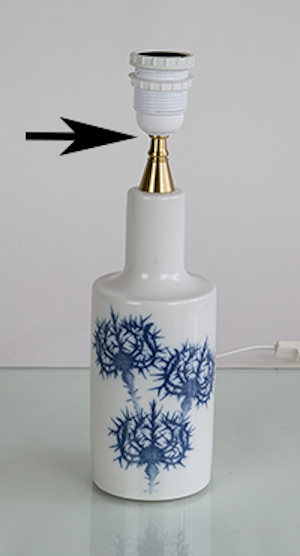
Where should you measure your lamp?
To help you find the right lampshade, we need to know the height of the lamp base itself.
Measure from the bottom of the lamp up to the spot the arrow shows in the picture. Do not include the socket itself.
Where should you measure your lamp?
To help you find the right lampshade, we need to know the height of the lamp base itself.
Measure from the bottom of the lamp up to the spot the arrow shows in the picture. Do not include the socket itself.
Send us your pictures and measurements
Send your pictures, measurements, and wishes to [email protected]. Once we have received the information, we will review the options and get back to you as soon as possible with our suggestions.
We look forward to helping you find a new lampshade!
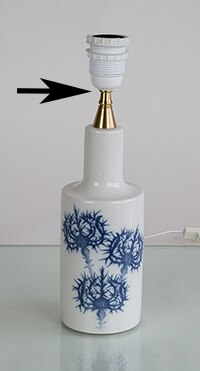
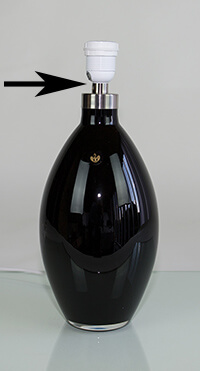
How to check if the chosen lampshade size fits your table lamp
First, you need to measure your table lamp:
Measure your table lamp's height up to the socket, as the arrow illustrates. (The socket should not be measured).
Which shape/model lampshade will suit your lamp best?
There are different things you should consider.
1. Shape of the lamp:
Tall slim lamps, e.g., candlestick lamps in silver, brass, etc., can use a relatively small lampshade, e.g., a Lene Bjerre shade or a cylindrical round shade, a Le Klint shade, an oval one possibly with brass or silver bands.
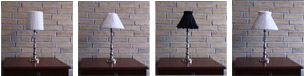
The slightly more stout lamp base needs a lampshade with a relatively large diameter at the bottom. You should not choose a tall slim lampshade model,
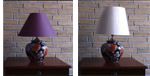
You might also want to look at the shape of the lamp; if you have an elongated lamp, you could choose an elongated lampshade, or a hexagonal shade for a hexagonal lamp, square shade for a lamp with a square base, etc.
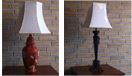
2. Which style would you like your lamp to match:
The style of your lamp greatly depends on the choice of lampshade; you can completely change the style of many lamp bases by choosing a different lampshade.
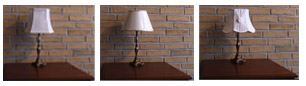
If you have an old Chinese lamp and are a bit tired of the oriental-inspired look, choose e.g., the more modern round cylindrical shade. If you want to emphasize the oriental style, the classic pagoda shade with trim is the obvious choice.
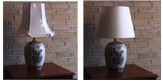
3. To avoid style clashes:
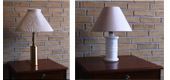
Design lamps like Le Klint, Holmegaard – here it would be a total style clash to put a shade with trim; most choose a sleek shade such as the well-known Le Klint shades or a smooth round shade.
Some lamps have a lot of style themselves – e.g., the Chinese, old English trophy lamps, etc. – Here a modern shade might fade away. If you have an old brass lamp, this lamp can completely change style, from being the elegant lamp with the exclusive look to being the sweet romantic cuddle lamp when choosing a sweet Lene Bjerre pleated shade.
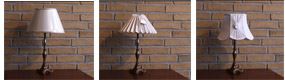
4. How an exciting, new lampshade can make your lamp smart and contemporary:
Before you discard your old lamp, sometimes you should consider if it could get a renaissance by purchasing a new shade. Often we ask our customers to forget about the old shade and preferably visit us in the store with the lamp; then we try new exciting models on the lamp and find the shade that today fulfills your wishes and style.
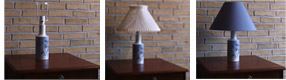
Which size lampshade should you choose?
There is no straightforward answer to this question, as it again depends on the lampshade model, style, and of course taste and preference – but the following might help.
If you have a lamp with a vase shape and want a square shade for it, the height of the shade should be the same height or slightly smaller (5-10%) than the height of the porcelain/glass/ceramic part.
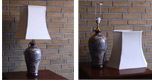
When you choose round shades in the cylindrical shape or the oval, a similar rule applies, but the shade here should be perhaps 20% shorter in height than the porcelain/glass/ceramic part.
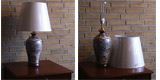
But again, if the shade is used for a candlestick shape lamp, the shade can easily be much smaller.

Style and fashion
Often you have an old shade, and it is naturally obvious to start with the size of this shade when choosing a new one. Look at the height and diameter at the top and bottom, and choose a shade that matches these measurements a bit.
The trend today is moving away from very flat round shades and choosing more cylindrical or oval shades.
The shades should not be as large as before. The trend is that shades today are often chosen one size smaller, i.e., maybe 2-4 cm lower.
When you choose round shades, you look more at the diameter than the height, and here it can be difficult to give a rule of thumb, but if you have an old shade, it is naturally obvious to start with the size of this shade when choosing a new one. Look at the height and diameter at the top and bottom, and choose a shade that matches these measurements a bit. - The trend today is moving away from very flat round shades and choosing more cylindrical or oval shades.
If you need help choosing the right shade model and size, etc., you might be inspired by our video:
Also see the video explaining about number system, socket types, child safety of sockets, lampshade holders, fabrics, etc.
Now to the slightly technical... To find the exactly right accessories for your lamp, which make the shade and lamp compatible, you need to know what type of socket your lamp has.
What is a socket?
A socket is the part of the lamp where the bulb is screwed in. Sockets come in many different designs. The most typical sockets are shown in the pictures below.
E27 Sockets (Diameter: 40 mm):
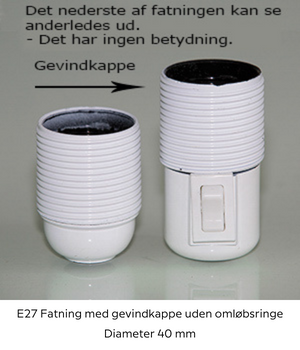
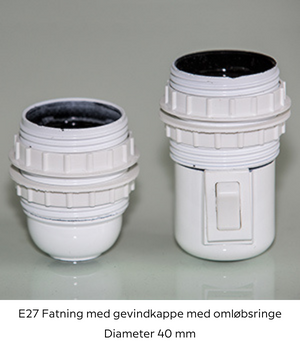
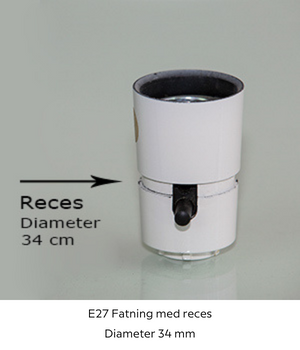
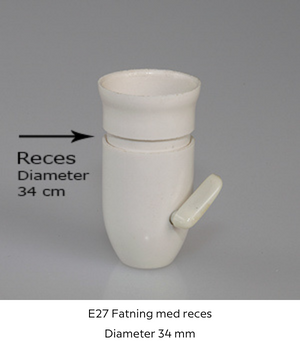
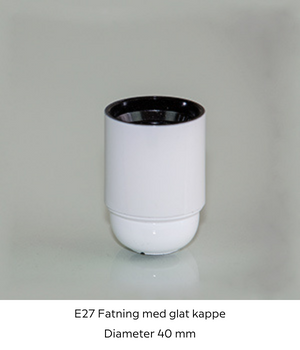
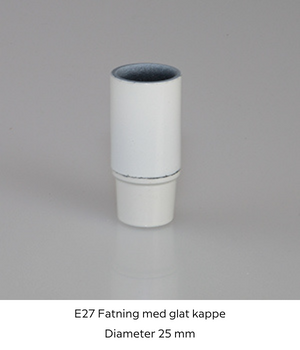
E14 Sockets (Diameter: 25 mm):
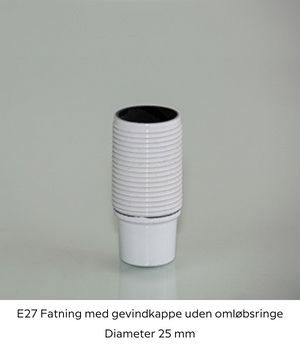
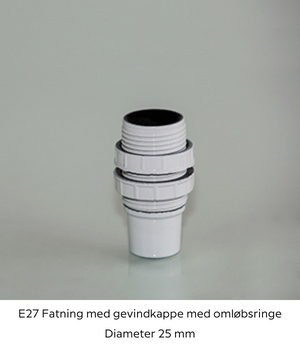
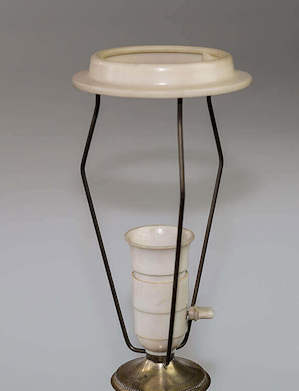
Old type socket:
Here you see an older type socket. This is a recessed socket but with a fixed shade holder attached. If your lamp has such a socket and holder, we suggest you choose an E27 recessed socket and follow the guide accordingly. Tip: Maybe the shade you have chosen can be used on the fixed holder, but we cannot guarantee this. If the shade you order cannot be mounted on your current fixed shade holder, we recommend that you cut off this holder as low as possible at the base with a bolt cutter. Then you can mount the shade with the optionally purchased mounting accessories.
Why are there two sockets in the same picture?
In two of the socket pictures there are two sockets in the same image. These two sockets are identical but with and without a switch. It does not matter whether your socket has a switch or not when choosing a shade and accessories.
With and without retaining rings
We have chosen to show sockets both with and without threaded caps (outer side with thread). If you have a socket with a threaded cap, in some cases you only need to consider whether you have two retaining rings if required to mount the shade.
You need the following for your lamp and shade to work together:
Shade holder
A shade holder is necessary when you want to use a lamp shade with support. Shade holders are mounted on the lamp socket and function as a holder for the lamp shade.
The shade holder comes in two sizes - one of 40mm and one of 34mm. New sockets with retaining rings require a 40mm holder. Older lamps often have a socket without retaining rings, so a 34mm holder should be used instead.
By measuring the socket diameter, you know whether the shade holder should be 40mm or 34mm. The diameter at the top of the holder, where the lamp shade is supposed to rest, is the same (10 cm) for both holders. Tip: if it says e.g. (Ø 40mm), the Ø means diameter.
Do you already have a shade holder?
If you think you already have a shade holder that can be used, please check if the diameter of the ring that should sit around the socket is the same as the one presented here. It is also important that the shade holder is height adjustable. This means it is possible to change the height of the shade holder so the shade's position on the lamp can be adjusted correctly.
How do you mount a shade holder?
We have many customers asking about shade holders because they are not always easy to figure out. Therefore, we have made a video where Lone shows how to choose the right shade holder for your lamp, how to disassemble a socket, and how to assemble a shade holder. Watch it below!
Retaining ring
Some sockets have a ring around them that can be unscrewed, where a shade holder can then be placed and the retaining ring can then be screwed back onto the socket, holding the shade holder in place, which makes the lamp shade stand stable.
You can find our range of retaining rings among our lighting spare parts.
Bulbs
When choosing a bulb, you again need to pay attention to the socket size. Additionally, you should consider the brightness you want as well as the color temperature that suits your needs.
Brightness is today measured in Lumens, while color temperature is indicated in the unit Kelvin. The higher the light temperature of the LED, the cooler the light it produces, and conversely; warm white requires the temperature to be below 3000K.
Don't miss free tips and a lot of great sales
DPH – Danish Porcelain House
Løkkegravene 49
5270 Odense N, Denmark
CVR-no.: DK61086013
Follow us on social media:



 We are e-approved