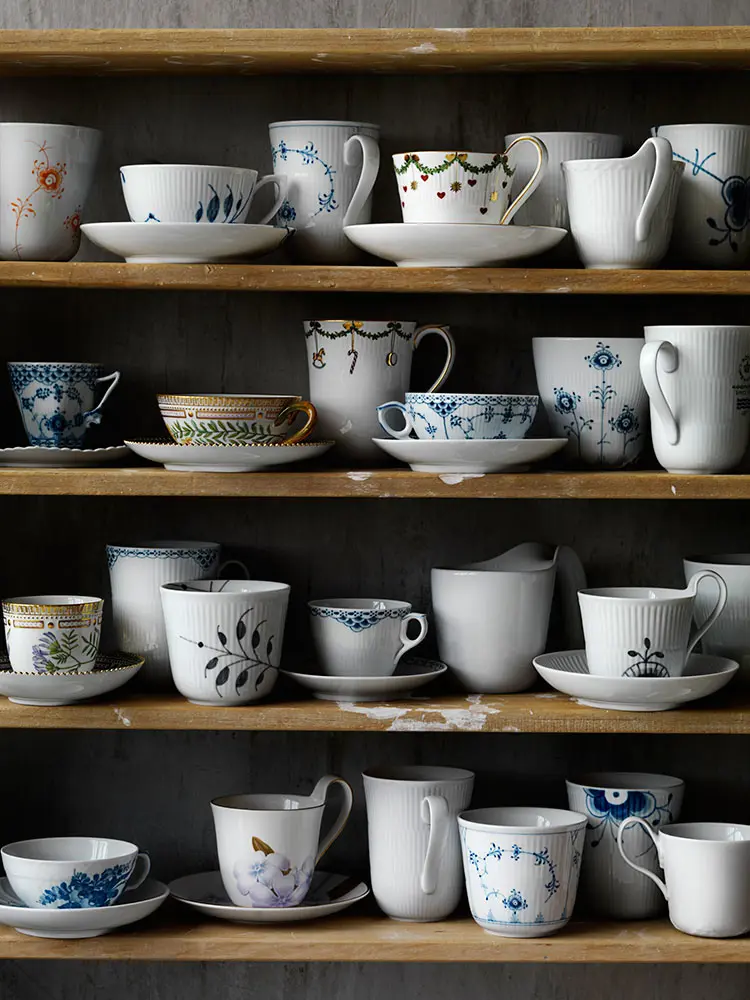
The Story of Royal Copenhagen Porcelain
The Royal Copenhagen factory was situated in an old mail court in Koebmagergade, Copenhagen.
It was decided from the very beginning in 1775, that the hallmark should be "Three Wavy Lines", symbolizing the three Danish straits (The Sound, The Little Belt and The Great Belt). With little variation all Royal Copenhagen products have been marked with this logo ever since.
The Royal Porcelain Factory
Right from the beginning the factory had serious problems with raw materials, firing, buildings, internal disagreements, etc. Everything seemed to be problematic in spite of the fierce efforts of Frantz Müller and his employees.
At the beginning of 1779 the economy was so bad, that the factory was taken over by the king and renamed " The Royal Porcelain Factory" - Abroad known as Royal Copenhagen.
In spite of the initial difficulties, the factory soon accomplished a high-quality production. Not until 1780 had the factory "gathered" enough articles to open up the shop that had been planned from the beginning. A shop was opened on the first floor in Koebmagergade. According to the cash books, the shop had nine customers on the first day of opening. The factory did not show any profits until 1795. And the Royal Family was always their biggest client.
By 1780 the rococo style is ousted in favour of the neo classical style with decorations in the contemporary German style. Naturalistic flowers in fresh colours as well as medallions in black or gray with typical motifs. Almost all figurines produced at the factory in those days were copies.
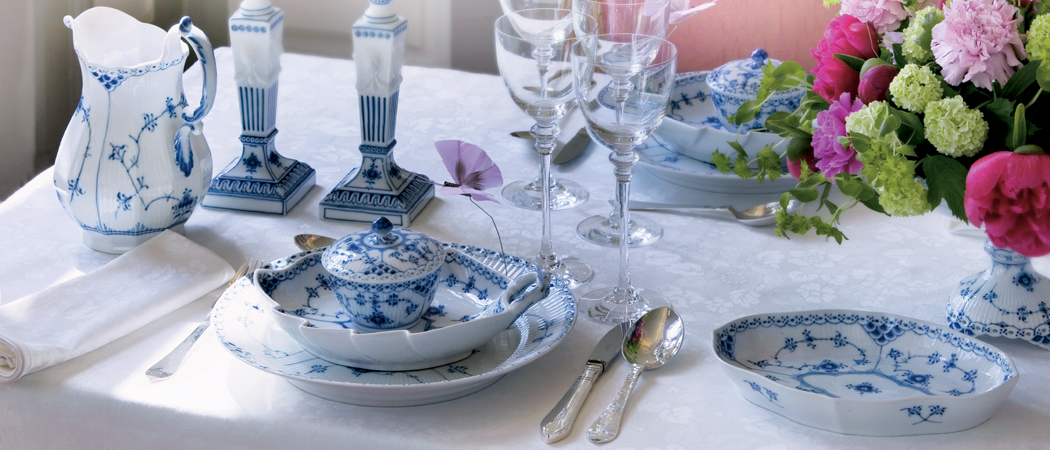
The oldest service
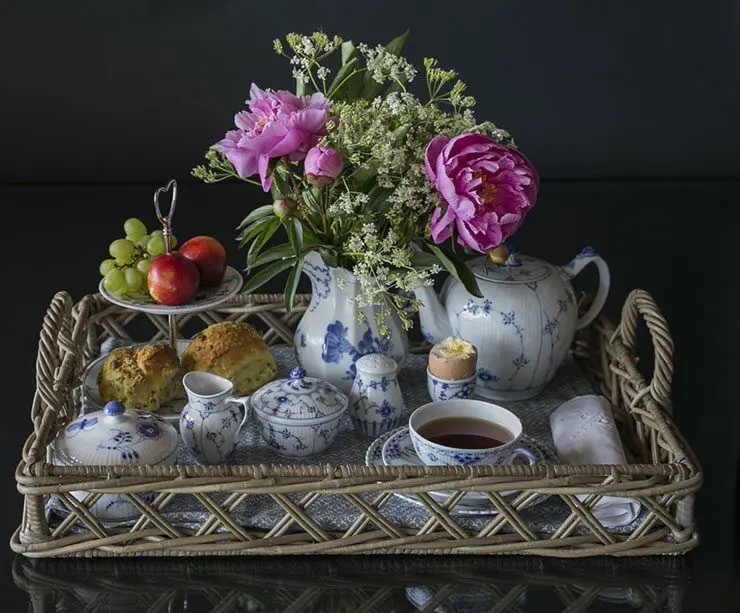
At the same time tableware in the blue and white colours were manufactured. The Blue Fluted service was produced right from the start, but it was the Flora Danica service that made the factory world famous. By late 1700's the factory survived on orders and commissions from the Royal family and the nobility. Especially tableware and big magnificent vases were popular. Articles that would today be priced in the million kroner class. Royal Copenhagen's first golden age ends at the beginning of the 19th century.
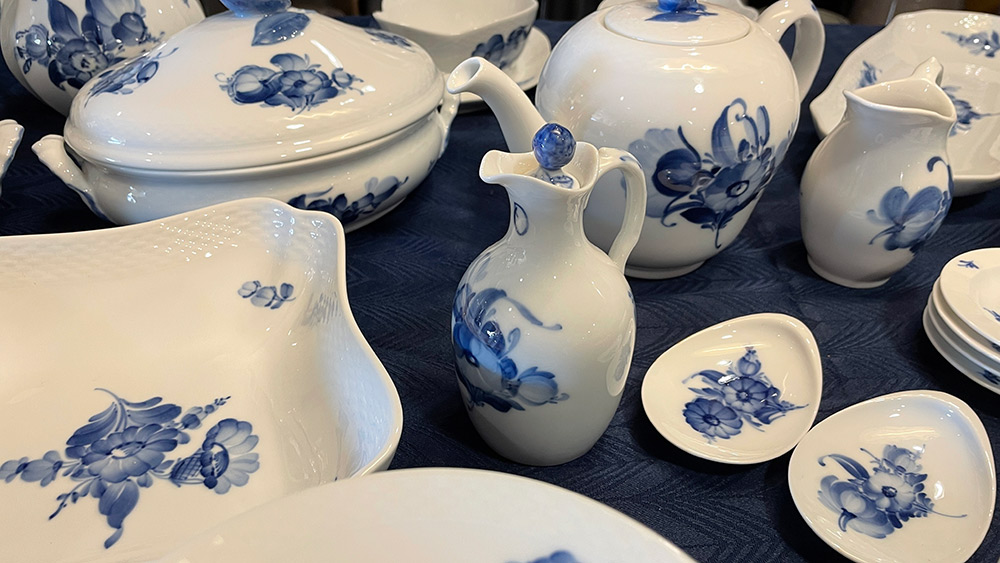
In 1779, the pattern Blue Flower (also copied from Meissen) is introduced.
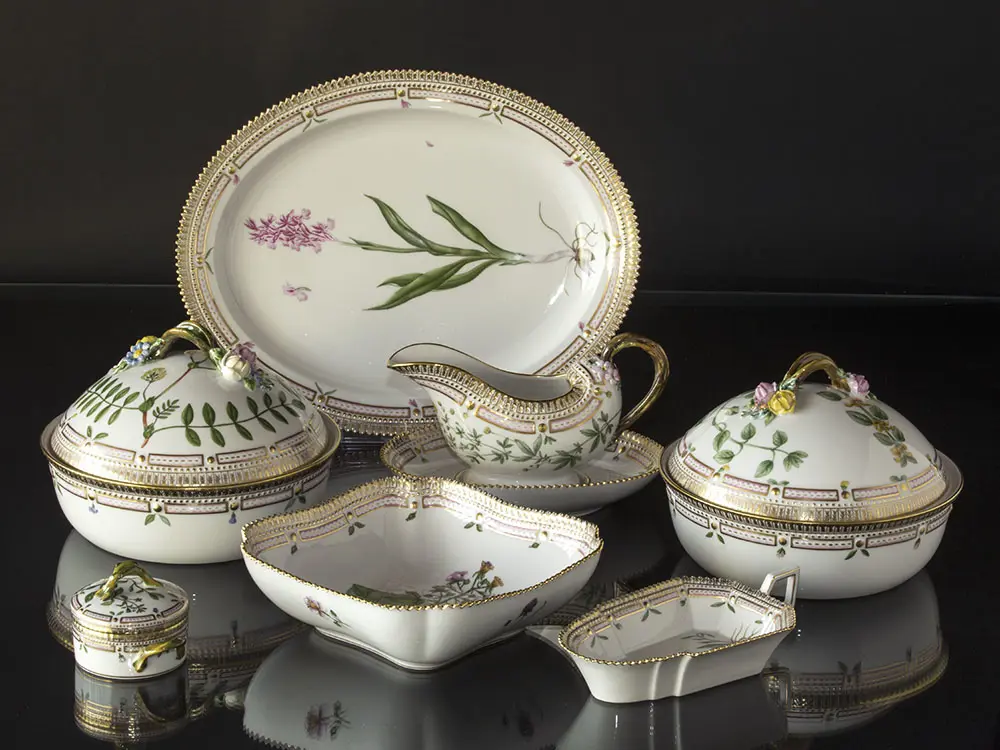
The biggest commission ever was the Flora Danica service. "The Flora Danica service" was ordered by King Christian 7th in 1790 - supposedly meant as a gift to Zarina Katarina 2nd of Russia. Due to the death of the Zarina, the set remained with the Royal family in Denmark.
The set was based on the national botanical works of the same name, published from 1762. A very closely defined job, carried out by the German flowerpainter Johann Christoph Bauer who emigrated from Nürnberg. The job lasted from 1790 till 1802, and almost cost him his sight. When delivered the service included 1802 parts. Part of the original set is still exhibited at The Rosenborg Castle. The original set is still in the possession of the Royal family, and it is said to be used on special occasions.
"The Pure Style"
Denmark, and thereby Royal Copenhagen, experienced recession following the bombardment of Copenhagen in 1807 and the national bankruptcy of 1813. There was shortage on most things including raw-materials for the porcelain production. Royal Copenhagen had to let most employees go in 1810, or put them on standby payment.
Progress in artistic development and innovation picked up in 1816. From The Royal Academy of Art professor G. F. Hetsch was hired to be the artistic leader in 1828. He advocated for "The Pure Style" and had studied the arts and the idiom of the Antiquity in Rome.
Thanks to him Royal Copenhagen started the production of the much coveted bisquit-figurines, giving the factory a badly needed financial improvement. Moreover he was a big propagator of the late empire style. The prospect paintings were also favorites of those years.
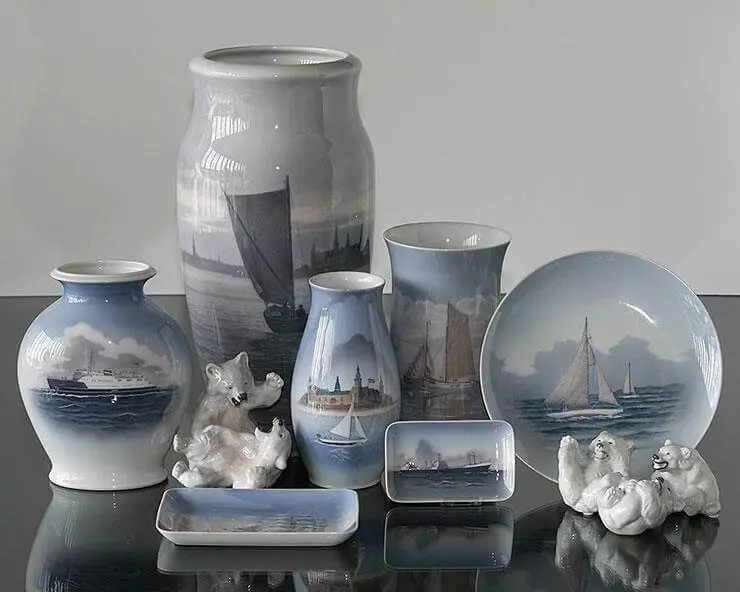
The Royal Copenhagen employees had received education from a French painter specializing in this art form. Ín the following period several items with motifs of for example Amalienborg Palace, The Round Tower and Rosenborg Castle were introduced. Until 1857 G.F. Hetsch held the post as artistic leader.
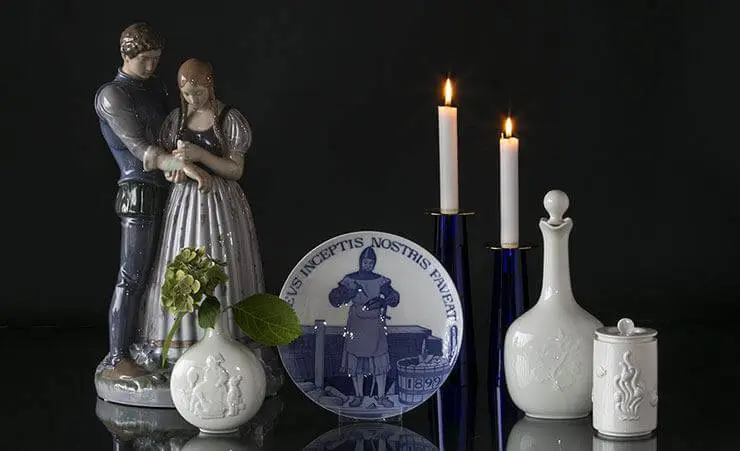
An apprentice becomes a competitor
The founder of Bing & Grondahl Frederik Vilhelm Grondahl was engaged as an apprentice in the throwing workshop in 1833. He stayed with Royal Copenhagen until 1852.
The absolute monarchy in Denmark was abolished in 1849. The old privileges and monopolies were dissolved and Royal Copenhagen was on its own.
Royal Copenhagen participated in its first official exhibition in London: The Crystal Palace World Exhibition in 1851 - the factory still under the artistic leadership of G. F. Hetsch.
On April 19, 1853, Bing & Groendahl was founded and became a direct competitor to Royal Copenhagen.
New times
New times of recession put Royal Copenhagen under the ministry of the interior in 1864. By 1868 the factory was privately owned until the successful faience factory Aluminia surprisingly bought Royal Copenhagen in 1882. Probably this is what ensured the the continued existence of Royal Copenhagen. After the takeover, The Royal Porcelain Factory moved to the Aluminia premisses in Smallegade, Frederiksberg.
The year of 1868 was also when the first female "bluepainter" was hired at The Royal Porcelain Factory. So far this job had exclusively been handled by men. Quickly this field of work was completely taken over by women.
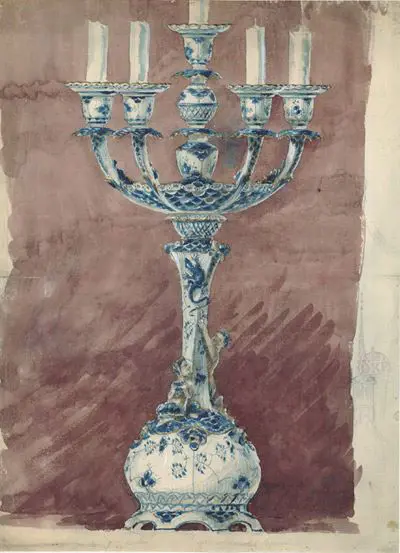
Administratively the two factories were merged, while they otherwise continued as two separate factories. The following year the Royal Copenhagen shop opened at Amagertorv. Arnold Krog was engaged as artistic leader, and he was responsible for the international breakthrough in Royal Danish porcelain. By the end of the 19th century the Aluminia factory "starved" in favour of Royal Copenhagen - in all respects.
Arnold Krog had from his very start at Royal Copenhagen already decided to "straighten up" the by now somewhat diluted blue pattern. In this period he designed the half and full lace versions of the Blue Fluted porcelain.
In 1980 Royal Copenhagen a store in Paris, France, and 7 years later another one on the fashionable "Old Bond Street" in London, England.
Customers all over the world wanted to acquire the new underglaze products. The porcelain factory had great success and the orders were pouring in.
During this period the Christmas plate was "invented", and factories all over the world followed in the steps of the Danish factories to produce the Christmas plates (and other decorative plates).
"The Fan" service was introduced in 1909 - designed by Arnold Krog. He had already in 1885 been inspired by a fan, but the service was not produced until 1909. It is also produced in green and in gold.
Knud Kyhn, sculptor, was engaged by Royal Copenhagen in 1904, where he stayed for the next 6 years, especially creating big figurines. He is one of several artists who have worked both at Bing & Groendahl and Royal Copenhagen. From 1909 he worked with Gerhard Henning at Royal Copenhagen. Gerhard Henning was a swedish-born artist who intoxicated with his opulent figurines inspired by the French 18th century art.
He often created figurines with small groups of people in an adventure style a la the Orient. Kyhn and Henning created several of Royal Copenhagen's big Pan (Faun) figurines, today absolutely coveted. Both artists worked at Royal Copenhagen several times.
By 1885 the Royal Copenhagen shop moved to Amager Torv 6, where it is still situated today.
New artists and production techniques
Patrick Nordström, a swedish ceramicist hired by Royal Copenhagen from 1912 to 1922, was in 1914 one of the first in Denmark to showcase stoneware at Royal Copenhagen. Patrick Nordström created a road for other artists in regards to experimenting with glaze for stoneware, etc. He always strived after perfection in unifying glaze and stoneware, and developed several new glazes over time.
The Royal Porcelain Factory has up through the 20th century continuously been able to renew and develop - constantly engaging new artists, and new or redeveloping various production techniques.
We have not spent a lot of time telling the Royal Copenhagen history later than the 1920's in this text, as - in our opinion - this part of the history is told better elsewhere. The production of already existing products and series such as Blue Fluted, Blue Flower and the Christmas plates etc. is still continued simultaneously with the development and production of numerous new products, following or ahead of styles and trends of the time.
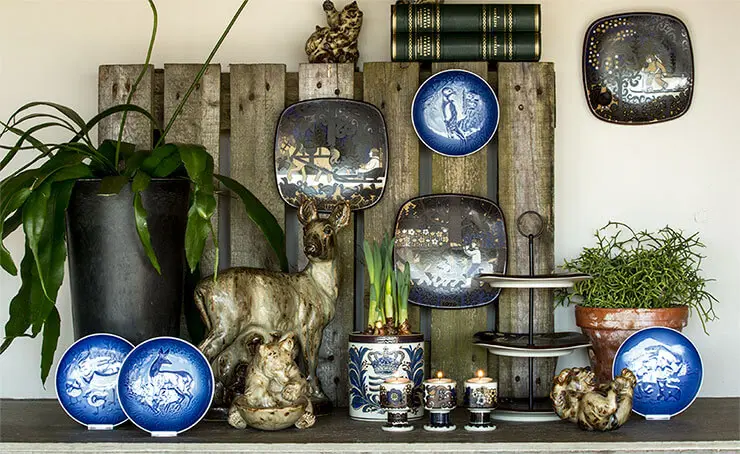
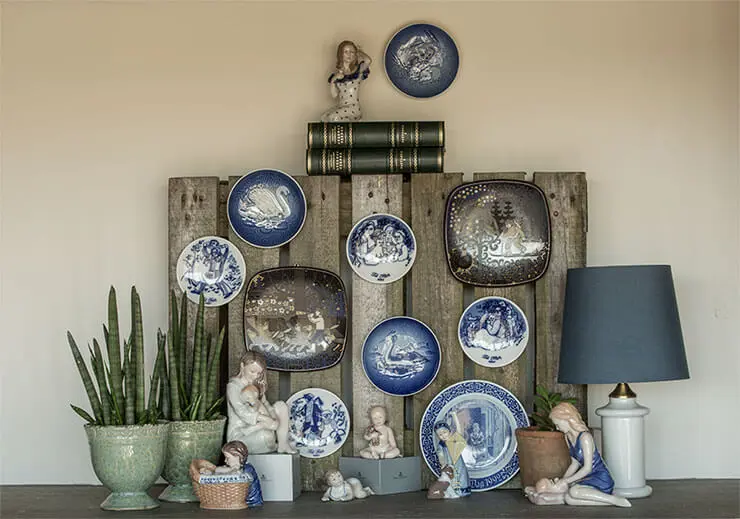
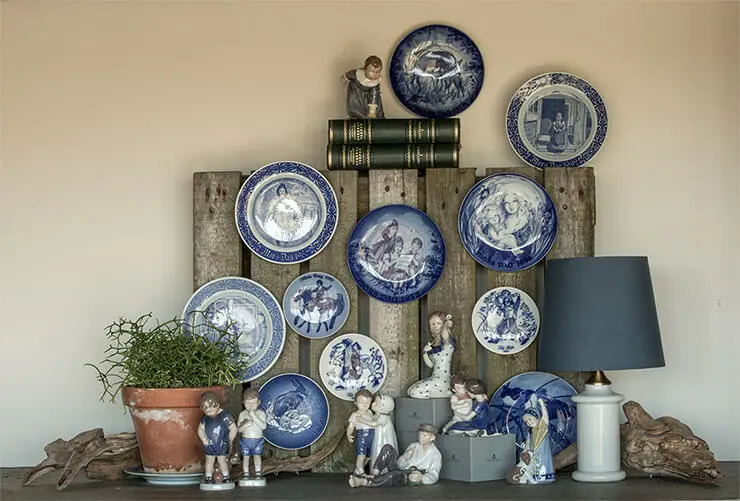
During the 1970's Royal Copenhagen experienced a large growth in the sales and production of various collectibles such as Christmas and Mother's Day plates, Annual bells, Annual mugs etc.
The Royal Porcelain Factory bought and merged with several other manufactures of the glass, porcelain or design producers in Scandinavia since the 1980's. Georg Jensen, KostaBoda Orrefors, Holmegaard Glass-works and others have merged with the old porcelain factory. Since the merger with Holmegaard Glassworks in 1985, The Royal Porcelain Factory has existed under the name Royal Copenhagen (often referred to as RC).
Artists to be mentioned in recent years could be Sven Vestergaard, Ursula Munch-Petersen, Monica Ritterband and many more. New products to be emphasized are various series, such as "Santa Claus", "Christmas in Denmark" and many others. The latest addition is "Blue Fluted Mega" - a re-design of the original Blue Fluted, created by Karin Kjaeldgaard-Larsen. Little details from the original service are "blown up" in big size.
One major reason for Royal Copenhagen's continuing success is the decision to prioritize the quality of decoration on figurines and tableware. Royal Copenhagen has an artistic and qualitative high standard, and they offer their employees a motivating and artistic environment.
Today Royal Copenhagen is part of Fiskars Group and the production takes place in Thailand.
Facts about Royal Copenhagen:
When was Royal Copenhagen established?
- Royal Copenhagen was established in 1775.
Why is the trademark of Royal Copenhagen three wavy blue lines?
- The three wavy blue lines of the Royal Copenhagen trademark represents the three straits of Denmark; The Sound, The Little Belt and The Great Belt.
Which is the most famous dinnerware of Royal Copenhagen?
- The most famous commonly available dinnerware from Royal Copenhagen is the Blue Fluted Dinnerware. Other than that there is the hugely expensive and delicate Flora Danica originally made for Zarina Catharina of Russia.
Who owns Royal Copenhagen today?
- Royal Copenhagen is currently a trademark of Fiskars.




 We are e-approved